
Similar articles


Track Limits in Formula 1: Monitoring Technology and the Debate Over Penalties
Track limits have become one of the most discussed topics in modern Formula 1. While the championship continues to evolve with faster cars, improved circuits and increasingly detailed sporting regulations, determining whether a driver has remained within the permitted boundaries remains a constant challenge. A fraction of a second can separate victory from defeat, making every corner exit and every centimetre of asphalt significant throughout a Grand Prix weekend.
The FIA has gradually introduced increasingly sophisticated methods of monitoring track limits. What was once judged almost entirely by race officials observing from trackside is now supported by high-speed cameras, electronic detection systems, video review and extensive telemetry. These technologies aim to deliver fairer decisions while reducing the possibility of inconsistent officiating. Despite these improvements, penalties for exceeding track limits continue to generate debate among teams, drivers and supporters. Some argue that modern technology ensures equal treatment for every competitor, while others believe that excessive intervention can overshadow the sporting spectacle. Understanding how these systems operate helps explain why track limits remain one of Formula 1’s most controversial regulatory topics.
Why Track Limits Exist in Formula 1
Track limits define the maximum area that competitors are permitted to use while racing. Under the FIA Sporting Regulations, a car is considered to have left the track if no part of it remains in contact with the white line marking the circuit boundary. This definition applies during qualifying, sprint sessions and Grands Prix, ensuring a consistent framework throughout every championship event.
The primary objective is fairness. Circuit designers create racing lines with carefully calculated corner radii, kerb profiles and runoff areas. Allowing drivers to extend beyond the intended boundaries could provide measurable advantages in corner speed, tyre preservation and lap time. Without clear limits, competitors would naturally exploit every available metre of asphalt, gradually changing the character of the circuit itself.
Safety is another important consideration. Modern runoff areas are designed to protect drivers when mistakes occur, not to become extensions of the racing surface. If leaving the circuit without consequence became common practice, drivers could intentionally use these areas at high speed, creating new safety concerns and placing additional stress on track infrastructure.
How Circuit Design Influences Track Limit Enforcement
Not every Formula 1 circuit presents the same challenges. Permanent venues such as Suzuka, Silverstone and Spa-Francorchamps feature combinations of grass, gravel and kerbs that naturally discourage drivers from exceeding the circuit boundaries. In these locations, the physical characteristics of the track often reduce the need for constant regulatory intervention.
Other circuits present a more complex situation. Modern venues with extensive asphalt runoff, including the Red Bull Ring, Lusail International Circuit and the Circuit of the Americas, allow drivers to continue at competitive speed even after crossing the white line. As a result, race control must rely more heavily on technological monitoring because visual deterrents alone are no longer sufficient.
Formula 1 has also introduced additional physical solutions where appropriate. Gravel strips have returned to selected corners at several circuits, while raised kerbs and redesigned runoff areas are increasingly used to discourage repeated infringements. These engineering changes complement electronic monitoring rather than replacing it, creating a more balanced approach to track limit management.
Technology Behind Track Limit Monitoring
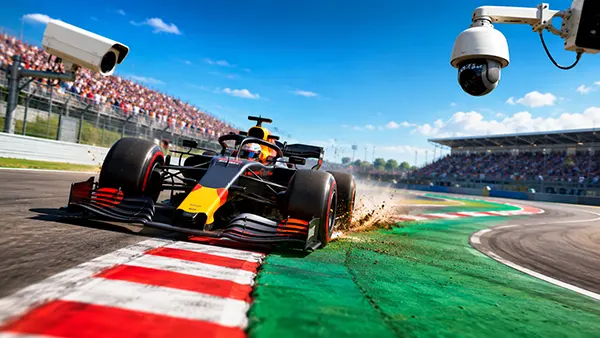
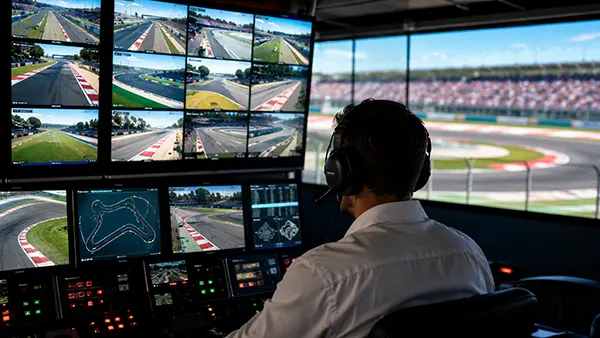
Formula 1 race control relies on several independent sources of information before confirming that a track limit violation has occurred. High-definition broadcast cameras positioned around the circuit provide continuous visual coverage, while dedicated FIA cameras focus specifically on corners that have historically generated frequent infringements. These video feeds are reviewed in real time by officials working in the Race Control centre, allowing incidents to be assessed within seconds.
Electronic monitoring has become increasingly important during recent seasons. Many circuits now use automated detection systems based on high-resolution cameras and specialised image-processing software that can determine whether all four wheels have crossed beyond the white line. These systems immediately alert race officials, who then verify the evidence before deleting a qualifying lap or issuing a warning during the race. Automation significantly reduces workload while improving consistency across hundreds of laps during a race weekend.
Telemetry and timing information provide an additional layer of verification. Every Formula 1 car continuously transmits detailed performance data to the FIA, including speed, steering angle, braking inputs and precise positioning around the circuit. Although telemetry alone is not used to judge track limits, it supports the overall review process and helps officials reconstruct incidents whenever a decision is questioned by a team.
Why Track Limit Decisions Still Create Debate
Even with advanced technology, track limit decisions remain controversial because regulations must be applied in situations that are rarely identical. A driver may exceed the white line while avoiding another car, recovering from oversteer or attempting to prevent an accident. Race stewards therefore consider not only the available evidence but also the wider context before determining whether a sporting advantage was gained.
Qualifying sessions often generate the greatest frustration. A lap that appears exceptional can disappear from the timing screens within moments if automated monitoring confirms that the car exceeded the circuit boundary at any point. Drivers sometimes discover that their fastest lap has been deleted only after returning to the pit lane, making track limit compliance one of the most demanding aspects of modern qualifying strategy.
Teams have generally welcomed the increased accuracy provided by technology, but many continue to argue that regulations should be easier for competitors and spectators to understand. Drivers have also called for greater consistency between different circuits, noting that some venues rely mainly on natural deterrents while others require intensive electronic monitoring. These discussions continue each season as Formula 1 seeks to balance sporting fairness, technological precision and enjoyable racing.
The Future of Track Limits in Formula 1
Formula 1 continues to refine the way track limits are managed as technology and circuit design evolve. The FIA regularly reviews data collected throughout each season, working with race organisers and circuit owners to identify corners where repeated infringements occur. Rather than relying solely on penalties, recent efforts have focused on reducing the opportunities for drivers to gain an advantage by leaving the racing surface in the first place.
Physical circuit modifications have become an increasingly effective solution. Gravel traps have returned to selected corner exits at several Formula 1 venues, while redesigned kerbs and narrower asphalt runoff areas naturally discourage drivers from exceeding the white line. These changes reduce the number of incidents requiring steward intervention and allow races to flow with fewer interruptions, while still maintaining the high safety standards expected at modern Grand Prix circuits.
Technology will nevertheless remain central to officiating. Camera systems continue to improve in accuracy, image-processing software is becoming faster, and automated detection is expected to play an even greater role during future championships. Although human race officials will continue to make the final decisions, technology provides increasingly reliable evidence that supports consistent application of the Sporting Regulations across every Formula 1 event.
Finding the Right Balance Between Precision and Racing
The debate surrounding track limits is unlikely to disappear because it reflects two equally important priorities. Motorsport requires clear and consistently enforced regulations, yet Formula 1 also depends on close, competitive racing where drivers are encouraged to push their abilities to the limit. Achieving both objectives simultaneously remains one of the sport’s most demanding regulatory challenges.
Many drivers have suggested that the best long-term solution is to create circuits where exceeding track limits carries an immediate sporting disadvantage rather than relying on post-race investigations or deleted lap times. When gravel, grass or carefully designed kerbs naturally penalise mistakes, competitors can clearly understand the boundaries without constant intervention from race control.
As of the 2026 season, Formula 1 combines advanced monitoring technology with evolving circuit design to create a more balanced approach than in previous years. While individual penalty decisions will continue to generate discussion, the overall direction of the championship demonstrates a commitment to improving fairness, maintaining safety and preserving the competitive integrity that defines the highest level of international motorsport.