
Similar articles
Spanish Rally1 Project RFEDA and RMC Motorsport: How an Independent Team Is Preparing for WRC 2027
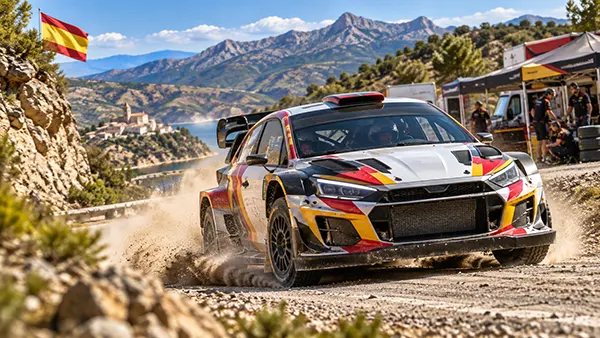
Spain is preparing one of the most unusual entries for the new era of the FIA World Rally Championship. WRT Rally1 Spain, created through a partnership between the Real Federación Española de Automovilismo (RFEDA) and RMC Motorsport, is developing an all-new car for the WRC27 regulations that take effect in 2027. Unlike the traditional factory programmes that have dominated the highest level of rallying, this project is being led by an independent Spanish constructor with the backing of the country’s national motorsport federation and support from the Consejo Superior de Deportes. Announced in April 2026, the programme has moved from an ambitious concept to a physical development project: the first chassis exists, work on the car is continuing and a dedicated engine programme has been chosen. There is still a considerable distance between building a prototype and starting a WRC rally, however. Testing, FIA homologation, reliability work, customer production and the final driver line-up all remain critical parts of the preparation before WRT Rally1 Spain can compete against established international opposition.
Why WRT Rally1 Spain Exists and What Makes the Project Different
The RFEDA and RMC Motorsport project was formally announced on 23 April 2026 around Rally Islas Canarias, one of Spain’s rounds of the World Rally Championship. Its official name, WRT Rally1 Spain, reflects a deliberate national identity, but the practical division of responsibility is clear. RMC Motorsport is responsible for designing, manufacturing and developing the car, while RFEDA provides institutional and sporting support. The Spanish Sports Council, the Consejo Superior de Deportes, is also supporting and collaborating with the programme. This arrangement is particularly significant because RFEDA became the first FIA member club to actively support a constructor entering the WRC under the new regulations. It is not simply a federation lending its name to an existing competition car. The objective is to create a Spanish-built WRC27 vehicle and establish the engineering, sporting and organisational structure required to operate it at the highest international level.
The timing is closely connected to the FIA’s decision to change the rules at the top of the WRC from 2027. The current generation of Rally1 machinery reaches the end of its regulatory cycle after the 2026 season, while the WRC27 rules have been designed specifically to lower the financial and organisational barriers that previously made a new top-class programme extremely difficult for an independent constructor. The FIA has set a target price of €345,000 for the new-generation car, representing a reduction of more than 50 per cent compared with the outgoing specification. Cost control is achieved largely through component specifications, simpler designs and an emphasis on durability rather than through a conventional team spending cap. Running costs are also supposed to fall through measures covering personnel, logistics and the use of local facilities. For a company such as RMC, those changes make a project that would previously have required manufacturer-scale resources considerably more realistic.
The new rules also change who can create a car. The FIA now groups manufacturers and independent tuners under the broader definition of a constructor, giving specialist competition companies a formal route into the championship. This is central to the Spanish project. RMC is not entering the WRC as the competition department of a major road-car manufacturer, and its new car does not have to be tied directly to a production model. The regulations allow considerable freedom in external design, including bespoke bodywork, provided the car stays within the FIA’s defined dimensions and technical requirements. That gives WRT Rally1 Spain the chance to establish its own visual identity while using the same basic safety and performance principles as its rivals. It also explains why the project is more than another private WRC entry: RMC intends to become a constructor of homologated WRC27 cars rather than simply buying and operating machinery produced elsewhere.
From Group N5 Experience to a Purpose-Built WRC27 Car
RMC Motorsport enters this programme with considerably more construction experience than its status as a new WRC entrant might suggest. Roberto Méndez founded the company in 2004, and the operation is based in Villablino in northern Spain. A particularly relevant part of its background is its work with Group N5 cars. RMC spent close to a decade designing, building and developing these rally cars for national and international competition, gaining experience in producing different body configurations around a competition-focused mechanical package. Méndez said in April 2026 that RMC had produced 14 different N5 cars using different body shells. That history does not automatically translate into WRC success, where the development demands, competition and homologation procedures are much tougher, but it means the company is not approaching its first WRC27 chassis as a first attempt at constructing a complete rally car.
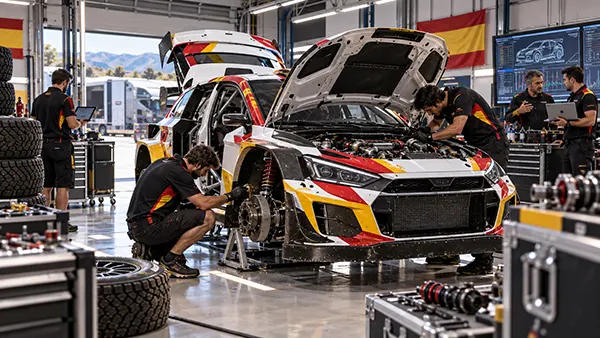
The WRC27 project nevertheless requires RMC to make a substantial step forward. The new vehicle is being developed from the outset for FIA homologation and for competition in the WRC’s highest category. Earlier in 2026 the team said that the car would use an original external design rather than copy the appearance of an existing road model. By early September, Méndez confirmed that the first chassis was already in existence, although he also acknowledged that the programme was running tighter on time than the team would have preferred. That distinction is important. Having a chassis is a meaningful engineering milestone, but it does not mean the competition car is finished. The chassis still has to become a fully assembled, functioning prototype, after which the development team must assess cooling, suspension behaviour, transmission reliability, engine performance, weight distribution, brakes, electronics and many other areas under real rally conditions.
Homologation is another reason why the project cannot be treated simply as a one-off prototype. WRT Rally1 Spain has already reported a visit to the FIA to work directly with the officials responsible for the homologation process. Under the rules confirmed for WRC27, a constructor must produce at least ten cars within 24 months of homologation and must be capable of supplying at least ten race-ready cars per calendar year to customers. This turns RMC’s experience as a builder into an important part of the business case. The company is expected not only to operate its own cars but also to make the design available to other teams. Building one fast prototype is therefore insufficient. Components have to be repeatable, replacement parts need to be available and customer cars must be practical to maintain. For an independent constructor, creating that production and support capability may prove almost as important as finding outright speed.
How the Car Is Being Developed for the 2027 Rules
The basic WRC27 specification is intended to retain the character of a top-level rally car without the extreme cost of the outgoing Rally1 generation. WRT Rally1 Spain’s car will use four-wheel drive, a tubular safety structure and double-wishbone suspension. The initial combustion-engine specification is based around a turbocharged 1.6-litre engine running on sustainable fuel. These ingredients will sound familiar to rally followers, but the wider philosophy is different: the FIA wants the cars to be simpler to produce, less expensive to purchase and easier for customer teams to operate. The regulations are planned around a ten-year cycle, giving companies such as RMC more time to recover the investment required to design and homologate a car. The long regulatory period is especially relevant for an independent company because the commercial value of its WRC27 programme depends on being able to build, sell, maintain and develop cars for more than a single short competition cycle.
The engine has been one of the clearest examples of how RMC’s plans have evolved during 2026. When the programme was announced in April, the team was discussing the possibility of obtaining an engine from an existing Rally2 manufacturer. That appeared to be a logical route because it would reduce the amount of development that RMC had to undertake itself. By September, however, WRT Rally1 Spain said it had changed direction. According to the team, manufacturers producing suitable Rally2 engines were not currently organised to supply an independent constructor with the number of units required for a programme of this scale. RMC therefore decided to develop its own engine using a production-derived unit already homologated in Group A, in accordance with the regulations. The decision adds work to the development schedule, but it also gives RMC greater control over future engine supply and reduces its dependence on another constructor.
The schedule has consequently become one of the project’s most important challenges. In April, RMC was working towards having the first car roll out during October 2026. By early September, the first chassis had been produced, but Méndez openly acknowledged that the team was somewhat behind where it would ideally have liked to be. That does not mean the programme has failed to meet its central objectives; it does mean that every remaining phase has to be managed carefully. A new rally car cannot be judged only by whether it starts and runs. It has to survive repeated kilometres on asphalt and gravel, cope with jumps, impacts, heat, dust and rapid service procedures, and do so without creating an unacceptable workload for mechanics. RMC has repeatedly placed reliability ahead of simply appearing at the earliest possible rally. For a new constructor, finishing competitive kilometres in 2027 would provide far more useful development information than rushing an immature car into an early event.
Testing, Dani Sordo and the Search for the Right Driver Line-up
The driver plan has also developed since the project was announced. Earlier information from RMC and RFEDA identified Javier Villa as one of the drivers expected to play an initial role in testing. Villa brings an unusual combination of experience from GP2, touring cars, hill climbing and rallying, making him useful during the first phase of evaluating a completely new vehicle. The situation became more significant in September when Méndez stated that Dani Sordo would be the car’s development driver. Sordo offers a very different level of WRC-specific experience. He has competed at the highest level of the championship for many years, has driven several generations of World Rally Cars and Rally1 machinery and has worked extensively with factory development teams. That experience is particularly valuable when a new constructor needs to distinguish between a basic prototype problem and the smaller set-up changes that can make a car faster and easier to drive.
Sordo’s development role should not be confused with a completed 2027 competition line-up. Méndez has indicated that Sordo may contest rallies he wishes to enter, but the team has not announced a definitive full set of crews for its first season. WRT Rally1 Spain said in September that discussions were taking place with experienced international drivers as well as younger competitors who are keen to establish themselves at world level. That combination would make practical sense. An experienced WRC driver can provide precise feedback during early development and help engineers establish a reliable baseline, while a younger driver can potentially grow with the project over several seasons. The team therefore does not necessarily have to choose between experience and youth. Those roles can be complementary, particularly during a first season in which development, selected competition appearances and preparation for a full 2028 programme will all take place at the same time.
RFEDA also sees the project as a way to strengthen the route from Spanish national rallying to the WRC. Federation officials have previously pointed to drivers such as Nil and Jan Solans, Efrén Llarena and Alejandro Cachón when discussing the depth of Spanish talent, although those comments should not be treated as confirmation that any of them will drive the RMC car. The distinction matters because speculation around a new national programme can quickly run ahead of confirmed information. As of September 2026, no final race line-up has been announced. What is confirmed is the intention to create opportunities for drivers with strong links to Spain while remaining open to internationally experienced competitors. In practical terms, the first priority remains the car itself. A driver announcement has limited value until RMC knows when the vehicle can complete representative tests, how reliable it is and which rallies can realistically form part of the 2027 programme.
What the 2027 Debut Plan Looks Like and What Still Has to Happen
Croatia is currently the official target for WRT Rally1 Spain’s first WRC appearance in 2027. In early September the team said it was working towards making Croatia Rally its debut, while stressing that the target could not yet be guaranteed because the final decision would depend on the progress of development and testing. There is an additional note of caution from Méndez himself. Speaking about the schedule in September, he suggested that Rally Islas Canarias may be a more realistic starting point because the project is short of time. These statements are not necessarily contradictory. Croatia provides an earlier objective around which the engineering programme can be organised, while the Canary Islands offer a later alternative if additional testing is required. The team has made clear that reaching the first rally with a properly developed and reliable car is more important than meeting an artificial debut date.
The wider first-season plan is intentionally limited. RMC and RFEDA do not expect to contest a complete WRC campaign in 2027. Earlier statements referred to competing in at least half of the championship, and the FIA’s homologation requirements explain why that figure is important: during the first year of a WRC27 car’s homologation, the constructor must participate in at least 50 per cent of the WRC events, with a minimum of two cars per rally. WRT Rally1 Spain has identified Spain and Portugal among its preferred European events and has also expressed interest in the South American WRC rounds during the second half of the year, potentially supplemented by other rallies. The exact programme remains provisional because, as the team noted in September, the final 2027 WRC calendar had not yet been published. Selecting events on different surfaces would nevertheless give RMC valuable information about how its new car behaves beyond a single type of road.
The intention is then to move to a complete WRC programme in 2028. That is consistent with both RMC’s stated plan and the FIA participation requirements, which increase to full-season involvement from the second year of homologation. At the same time, RMC will have to develop its customer operation. The homologation rules do not allow a constructor to create a handful of cars purely for its own factory-supported effort; it must be capable of supplying competition-ready WRC27 cars to customers. That could eventually become one of the project’s strongest advantages. RMC has spent years building and supporting rally machinery for private competitors, so customer relationships are already part of its normal business rather than a completely new activity. Reports in September indicated considerable early interest from drivers and teams. Interest, however, still has to become firm orders, and orders depend on the final car proving competitive, reliable, properly homologated and supportable over a full season.
Why the RFEDA-RMC Project Matters for the Next WRC Era
WRT Rally1 Spain is an early test of the central idea behind the 2027 regulations: that the highest category of the WRC should no longer be realistic only for a small group of major automotive manufacturers. The FIA has reduced the target cost of the cars, opened homologation to specialist constructors and created regulations that give greater freedom over external design. It has also made customer supply part of the constructor’s obligations. RMC fits that concept closely. It is a specialist competition company with previous experience building rally cars for customers, but without the industrial scale or marketing budget of a global vehicle manufacturer. RFEDA’s involvement adds another unusual element because a national sporting authority is helping create the route into the championship rather than merely regulating domestic competitors. If the model works, other engineering companies and national motorsport organisations will have a practical example of how an independent programme can reach the WRC.
The opportunity should not obscure the scale of the challenge. Toyota is developing its own WRC27 car with the resources and experience of an established world championship operation, while the independent RallyOne Project is also preparing new machinery. The top category will additionally go through a transition in 2027 and 2028, with eligible Rally2 cars using the new Rally2-WRC-Kit able to compete alongside WRC27 machinery. RMC therefore has to enter an environment containing several different approaches to cost, development and competition. Its first objective is unlikely to be beating a mature factory operation immediately. More meaningful early measures will include reliable finishes, a manageable gap to the fastest cars, consistent performance on different surfaces, successful homologation and the ability to support two or more cars without serious technical or logistical problems. Progress in those areas would give the team a foundation from which outright competitiveness could be pursued.
As of 14 September 2026, the Spanish project has moved far enough to be regarded as a genuine WRC27 programme, but it is still in the development stage. The partnership between RFEDA and RMC Motorsport is official, the first chassis has been produced, an independent engine strategy has been chosen, Dani Sordo has been identified for development work and a partial 2027 WRC campaign is being planned. At the same time, the car still has to complete its assembly, testing and FIA homologation before any championship participation is guaranteed. Croatia remains the public target for the first appearance, with the Canary Islands regarded by Méndez as a potentially more realistic alternative if additional preparation time is needed. The next major evidence of the project’s progress will therefore come not from announcements but from a running car, meaningful test mileage and successful homologation. Those steps will determine whether Spain’s independent Rally1 effort can turn an ambitious national engineering project into a sustainable presence in the WRC.