
Similar articles

Formula 1 Returns to Portugal and Turkey in 2027: New Calendar and Ten Sprint Races
Formula 1 has confirmed significant changes to its 2027 calendar, bringing the Portuguese and Turkish Grands Prix back after six-year absences and increasing the number of Sprint weekends from six to ten. Announced by Formula 1 and the FIA on 16 September 2026, the schedule features 24 races across 22 countries, beginning in Bahrain on 14 March and ending in Abu Dhabi on 12 December. Portugal’s Portimão circuit returns in June, while Istanbul Park stages the Turkish Grand Prix in October, subject to FIA circuit approval. The expanded Sprint programme also introduces shorter races at five venues that have never hosted the format, including Monaco. Together, these developments will reshape the rhythm of the championship without increasing the total number of Grands Prix.
Portugal and Turkey Return to the Formula 1 Calendar
The return of Portugal and Turkey restores two circuits that last appeared during the disrupted 2020 and 2021 seasons. Both venues earned considerable recognition for their challenging layouts, but neither remained on the calendar once Formula 1 resumed its more conventional international schedule. Their inclusion in 2027 reflects separate agreements with Formula 1 rather than temporary arrangements to replace cancelled races. Portugal has secured a two-year contract covering 2027 and 2028, while Turkey has agreed to host the championship for five seasons, from 2027 through 2031. These commitments provide a clearer long-term future for both events than their previous appearances during the pandemic.
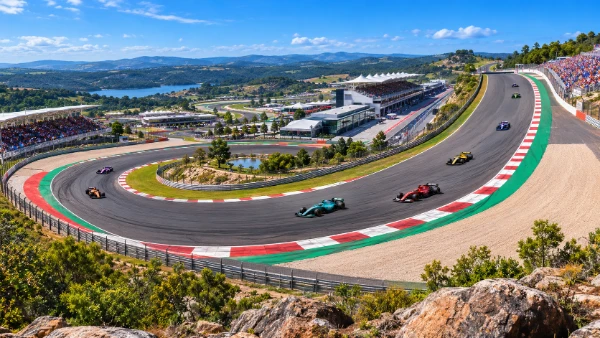
The Portuguese Grand Prix will take place at the Autódromo Internacional do Algarve in Portimão from 18 to 20 June 2027, with the main race scheduled for Sunday, 20 June. Located in southern Portugal, the circuit opened in 2008 and measures 4.653 kilometres. Its steep climbs, sudden descents and mixture of fast and slower corners distinguish it from many modern Formula 1 venues. Drivers must manage changes in visibility as the road rises and falls, while the approach to the first corner offers a realistic overtaking opportunity. The event follows Monaco and precedes the British Grand Prix at Silverstone, placing Portugal firmly within the European section of the season.
The Turkish Grand Prix returns to Istanbul Park from 1 to 3 October 2027, with the race planned for Sunday, 3 October. The circuit first hosted Formula 1 in 2005 and was a regular championship destination until 2011 before returning in 2020 and 2021. Its approximately 5.34-kilometre layout is particularly famous for Turn 8, a long, demanding left-hand corner with multiple apexes. Istanbul Park also features substantial elevation changes and several opportunities for overtaking. The 2027 event is positioned between the Azerbaijan and Singapore Grands Prix, although its inclusion remains subject to the circuit receiving the necessary FIA homologation.
Why Portimão and Istanbul Park Matter to Formula 1
Portugal has an extensive Formula 1 history extending well beyond Portimão. The country first hosted a World Championship Grand Prix in Porto in 1958, followed by events at Monsanto and Estoril. Estoril became particularly significant when Ayrton Senna secured his first Formula 1 victory there in 1985, driving for Lotus in wet conditions. More recently, Portimão hosted the Portuguese Grand Prix in 2020 and 2021, both won by Lewis Hamilton. His 2020 victory was especially important because it was his 92nd career win, taking him beyond Michael Schumacher’s previous record of 91. The returning race therefore connects several distinct periods of Portuguese motorsport history.
Istanbul Park also has a memorable record, particularly because its layout rewards commitment and precise car control. Felipe Massa won three consecutive Turkish Grands Prix between 2006 and 2008, while the 2010 event is remembered for the collision between Red Bull teammates Sebastian Vettel and Mark Webber as they contested the lead. The circuit gained further attention in 2020, when Lewis Hamilton won a rain-affected Grand Prix and secured his seventh World Drivers’ Championship. The demanding conditions highlighted how quickly Istanbul Park could expose differences in tyre management and driver confidence. Its 2021 race, won by Valtteri Bottas, was the last Turkish Grand Prix before the newly announced return.
The two returning venues offer contrasting characteristics that could influence the competitive order. Portimão rewards cars with predictable handling over changes in elevation, while Istanbul Park places considerable demands on stability through prolonged, high-speed corners. Neither event has been designated as a Sprint weekend for 2027, meaning both are scheduled to follow the traditional Grand Prix format with three practice sessions, qualifying and Sunday’s race. Their return also affects the wider calendar: Zandvoort is absent following the conclusion of the Dutch Grand Prix’s run in 2026, and Barcelona does not feature in 2027 as part of its new alternating arrangement with Belgium. Madrid remains Spain’s scheduled venue for the season.
The 2027 Formula 1 Calendar: 24 Grands Prix Across Five Continents
The 2027 championship begins with pre-season testing at Bahrain International Circuit from 24 to 27 February, followed by the Bahrain Grand Prix on 12–14 March and the Saudi Arabian Grand Prix on 19–21 March. Australia moves from its traditional opening position to the third round, scheduled for 2–4 April in Melbourne. Japan follows at Suzuka on 9–11 April, with China hosting the next race in Shanghai on 16–18 April. Miami takes place from 30 April to 2 May before Formula 1 returns to Canada on 21–23 May. This opening sequence contains seven Grands Prix, including three Sprint weekends, and will provide the first extended comparison of teams’ performance across different types of circuit.
Europe takes centre stage from June through September. Monaco hosts round eight on 4–6 June, followed by Portugal on 18–20 June and Great Britain on 2–4 July. Austria follows on 9–11 July, Belgium on 23–25 July and Hungary from 30 July to 1 August. After the summer interval, the championship resumes at Monza on 3–5 September and moves to Madrid for the Spanish Grand Prix on 10–12 September. Azerbaijan closes this part of the schedule on 24–26 September. Silverstone, Spa-Francorchamps, Monza and the returning Portimão circuit provide a varied selection of established European racing venues, while Madrid represents a comparatively recent addition to the championship’s international programme.
The final eight rounds begin in Turkey on 1–3 October, followed immediately by Singapore on 8–10 October. Formula 1 then travels to Austin for the United States Grand Prix on 22–24 October, Mexico City on 29–31 October and São Paulo on 5–7 November. Las Vegas hosts round 22 from 18 to 20 November, followed by Qatar on 3–5 December and the Abu Dhabi finale on 10–12 December. This arrangement creates a particularly demanding closing period, with races across several time zones and three Sprint events in the final six Grands Prix. The championship will finish almost nine months after the first race, leaving limited room for teams to recover from a prolonged run of disappointing results.
What Changes in the 2027 Schedule Compared with 2026?
Although the number of Grands Prix remains at 24, several changes distinguish the new season from 2026. Bahrain replaces Australia as the opening round, moving the championship’s first race from Melbourne to Sakhir. Portugal and Turkey return, while the Dutch Grand Prix at Zandvoort disappears from the schedule. Barcelona is also absent, with the Circuit de Barcelona-Catalunya entering an arrangement to alternate with Spa-Francorchamps in future seasons. Belgium retains its place in 2027, and Madrid continues as the Spanish Grand Prix venue. These changes demonstrate that an unchanged total of 24 races does not necessarily mean the same circuits will appear every year.
Calendar organisation is another important consideration. Formula 1 has grouped several races geographically, including the opening Bahrain–Saudi Arabia pairing, the Australia–Japan–China sequence and the late-season American rounds. Such arrangements can help reduce unnecessary movement of equipment and personnel between distant regions. However, the championship still requires extensive international transport, particularly when moving between Europe, Asia and North America. The October sequence from Azerbaijan to Turkey and Singapore illustrates both the benefits and limitations of geographical planning. Teams will also face consecutive race weekends at several points, increasing the importance of preparation, staffing and reliable equipment throughout the season.
The calendar creates different practical considerations for spectators planning to attend races. Portugal’s June date places the Grand Prix within the Algarve’s busy tourism season, so accommodation and transport arrangements may require early attention. Istanbul’s October event will offer a different seasonal setting from the summer races held there before 2012. Fans should also distinguish between announced race dates and detailed session timetables, which may be confirmed or adjusted separately. The official Formula 1 calendar provides the latest schedule, while organisers publish event-specific information about ticket availability, access and local arrangements. For Istanbul, the FIA homologation requirement remains an additional point to monitor before the event.
Ten Sprint Races in 2027: How the Expanded Format Will Work
The most substantial sporting change to the calendar is the increase from six Sprint weekends in 2026 to ten in 2027. The selected venues are Bahrain, Australia, Japan, Canada, Monaco, Great Britain, Italy, Brazil, Qatar and Abu Dhabi. This means that more than 40% of the season’s 24 Grands Prix will feature an additional competitive race. Five circuits will host a Sprint for the first time: Sakhir, Melbourne, Suzuka, Monaco and Yas Marina. The remaining five venues have previous experience of the format, including São Paulo, which has been a regular Sprint destination since its introduction in 2021.
The first Sprint takes place in Bahrain on 12–14 March, followed by Melbourne on 2–4 April and Suzuka on 9–11 April. Canada hosts its Sprint on 21–23 May, with Monaco following on 4–6 June. Silverstone’s Sprint weekend is scheduled for 2–4 July, Monza’s for 3–5 September and São Paulo’s for 5–7 November. The final two take place on consecutive weekends in Qatar on 3–5 December and Abu Dhabi on 10–12 December. This distribution places three Sprints within the opening four Grands Prix and reserves two for the championship’s final stages, potentially making both the beginning and end of the season more influential in the title contest.
Formula 1 has supported the expansion with audience research published alongside the calendar announcement. According to the championship’s figures, total viewership during Sprint weekends has been 12% higher than during weekends without the format. Formula 1 also reported that 82% of surveyed Sprint-weekend attendees considered the additional race valuable to their ticket, while 75% of surveyed fans believed Sprints improved the championship calendar. These are Formula 1’s own reported figures rather than independent guarantees of audience growth in 2027. Nevertheless, they help explain why organisers have chosen to increase the number of shorter races without adding further full-length Grands Prix.
How Sprint Weekends Could Influence the 2027 Championship
A Sprint is a short race covering approximately 100 kilometres, usually taking around half an hour and requiring no mandatory pit stop. Under the announced format, Friday includes one practice session followed by Sprint Qualifying, which determines the starting order for Saturday’s shorter race. The Sprint then takes place before the separate qualifying session for Sunday’s Grand Prix. Points are awarded to the first eight finishers, with eight points for victory, seven for second place and progressively fewer down to one point for eighth. The Sprint result does not directly determine the starting grid for the Grand Prix, allowing drivers to compete for additional championship points without replacing the main qualifying contest.
Ten Sprint weekends could have a meaningful effect on the Drivers’ and Constructors’ Championships. Across the season, a driver could theoretically earn 80 points from Sprint victories alone, provided the existing scoring system remains unchanged. That is equivalent to more than three standard Grand Prix wins at 25 points each. Teams with competitive cars from the opening round could therefore establish an advantage earlier than usual, while consistent top-eight Sprint finishes may become increasingly valuable during a close championship. Reduced practice time also matters: engineers have fewer opportunities to adjust their cars before competitive sessions begin, raising the importance of preparation and decisions made during the opening practice hour.
Monaco represents one of the most interesting experiments within the expanded programme. Overtaking has traditionally been difficult on its narrow streets, making qualifying position particularly important. Adding a Sprint provides another competitive session, but it does not remove the physical limitations of the circuit. Bahrain and Suzuka offer different challenges, with greater opportunities for changes in race position and contrasting demands on tyres. Abu Dhabi’s first Sprint adds an extra points-paying race to the final weekend, potentially affecting a championship that remains undecided in December. The 2027 season will therefore be defined not simply by the return of Portugal and Turkey, but by how teams adapt to a calendar with more competitive sessions and fewer opportunities for practice.