
Similar articles
MotoGP: Standing Starts — How Teams Optimise the Launch and Where Positions Are Lost
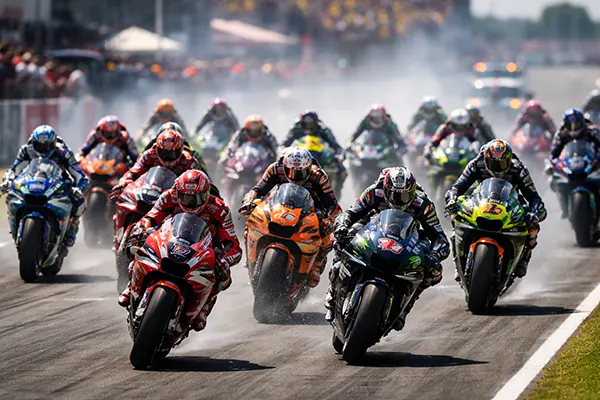
A MotoGP start is a short, brutal test of repeatability. Riders have less than a heartbeat to react, a few metres to load the rear tyre without spinning it, and only seconds before the first braking zone forces the whole pack into one line. By 2026 the bikes are still using sophisticated electronics and start devices, but the start is not “automatic”: the fastest launches happen when a team’s setup matches a rider’s feel, and the rider delivers the same inputs under pressure.
What a “good launch” is made of in 2026
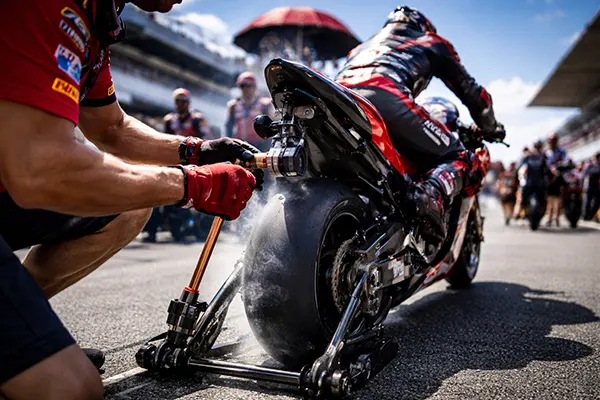
Teams treat the launch as a controlled slip problem. The clutch must transmit enough torque to accelerate hard, but not so abruptly that it spikes wheelspin or lifts the front wheel. That balance depends on the clutch pack condition, lever travel, hydraulic feel, and—crucially—the rider’s learned timing for feeding the lever. Small changes in friction material temperature and bite point can turn a clean start into a bog or a smoke show in the space of one grid wait.
Electronics do help, but within tight limits. MotoGP’s spec electronics ecosystem means teams work with a standardised ECU baseline and shared constraints, so the gains come from calibrating maps, engine-brake behaviour, torque delivery, and anti-wheelie logic to a specific rider and tyre condition rather than “finding a secret launch mode”. The rider still has to manage the clutch and initial throttle, and any mismatch between map assumptions and real grip shows up instantly as either spin (lost drive) or intervention (lost acceleration).
Then there’s the hardware that changes geometry at the start. In 2026, holeshot and ride-height concepts are still part of the picture, even as the sport has already committed to banning ride-height and holeshot devices entirely from 2027. That looming change is a reminder of how influential these devices have been in making launches more consistent, and why teams obsess over every detail of engagement and release timing.
How teams tune launch settings without chasing myths
A proper launch setup begins in practice, not on Sunday. Crews log repeated practice starts with controlled variables: tyre age, surface temperature, fuel load, and clutch temperature window. The goal is to build a “launch envelope” where the rider can make the same lever movement and throttle application and get the same forward drive. If the data shows large swings, the fix is often mechanical (lever ratio, fluid, clutch pack condition) rather than another software tweak.
Mapping work is about predictability. Teams focus on smooth torque ramping, consistent engine response around the first few thousand revs where the clutch is slipping hardest, and anti-wheelie behaviour that supports acceleration rather than killing it. Too aggressive an anti-wheelie strategy can look “safe” in the data yet cost positions because the bike simply will not accelerate as hard as the rider expects. Too little control, and the bike wheelies, forcing the rider to roll out and lose metres.
Finally, riders rehearse the sequence until it becomes muscle memory: clutch to the correct preload point, revs stabilised, body position forward, and a planned first-50-metre strategy. Many starts are lost because a rider changes their routine under stress—gripping the lever harder, releasing earlier, or chasing a reaction time that is not realistically repeatable. The best teams build routines that survive nerves.
Where positions are most often lost: the first two seconds
The most common loss is a launch that “bogs”. The rider releases the clutch slightly too much, the revs drop, and the engine falls out of the ideal torque region. The bike hesitates, and even a half-bike-length deficit becomes two or three places when everyone behind is accelerating cleanly. Bogs often happen when grip is higher than expected (the rider releases too fast) or when the clutch bite point shifts compared with practice starts.
The opposite problem is wheelspin. If the rear tyre spins early, the bike accelerates less than the engine noise suggests. Riders then face a nasty choice: keep it pinned and risk a bigger slide, or roll out and accept the loss. Even when traction control catches it, intervention can flatten acceleration enough to hand positions away. Starts on a cooler track, on the dirty side of the grid, or with a tailwind can make spin more likely than the rider’s Friday muscle memory expects.
Wheelies are the third classic trap. A front wheel that lifts too high forces the rider to close the throttle or let the electronics cut power. Either way, the bike stops accelerating at the exact moment it should be building speed. This is why body position matters so much: a rider who is a touch late moving forward can lose a place before they even cross the painted grid box lines.
The “small” details that create big gaps
Grid position is not just about line choice into Turn 1; it’s about grip and rubber. Some circuits have a clear clean side and dirty side, and the difference can show up as immediate wheelspin or a bog. Teams look at where cars and support classes lay rubber, how the sun hits the grid, and whether a particular slot tends to hold dust. Riders who ignore this and launch with a one-size-fits-all routine often pay for it.
Device timing can also bite. Holeshot-style systems are meant to keep the bike lower and more stable at the start, but they add another step and another potential failure mode. A poor engagement, or a release that happens at the wrong moment, can unsettle the bike and force a throttle correction. Even when nothing “breaks”, a rider can lose metres if the bike’s attitude changes mid-launch and they hesitate.
Start procedure discipline matters more than fans realise. MotoGP has tightened and clarified start procedures and penalties in recent seasons after high-profile grid confusion, and that has pushed teams to be more systematic about routines at the lights. If a rider is distracted—by a dashboard message, a late setup adjustment, or uncertainty about procedure—reaction and execution suffer, and the launch becomes messy.
Optimising for Turn 1: the launch is only half the job
Plenty of riders “win” the first 50 metres and still lose positions by Turn 1 because their launch was not aligned with their braking plan. If the bike arrives at the braking zone slightly out of position, the rider may be forced onto a tighter line, brake earlier, or stand the bike up to avoid contact. Teams therefore model the start as a sequence: launch → settle → shift pattern → first braking marker.
Gearing and shift strategy are underrated parts of this. A launch that requires an early upshift can be fragile: any hesitation, wheelie, or traction event can disrupt the shift and ruin drive. Some setups prioritise a smoother torque curve in first and second rather than the absolute hardest hit, because the rider can then carry speed all the way to the braking zone without a drama moment that costs three bike lengths.
Tyre behaviour is also a 2026 reality that shapes starts. Moto note: MotoGP has confirmed that Michelin’s role as sole tyre supplier ends after the 2026 season, with Pirelli taking over from 2027. That matters because teams in 2026 are operating in the final year(s) of a known tyre philosophy, and they’ve built launch routines around how that rear tyre bites when it’s cool, when it’s hot, and when it’s been heat-cycled in practice starts.
What changes are coming, and what still won’t change
From 2027, the sport has committed to removing ride-height and holeshot devices altogether. In 2026 that future already influences how teams think: anything that improves repeatability through rider technique, clutch stability, and clean torque delivery will carry over, while device-dependent “shortcuts” will not. This is one reason rider coaching on starts has become more formal, with drills focused on clutch timing, body position, and reaction routines.
Front ride-height devices have already been restricted compared with the earlier “anything goes” period, and the direction of travel is clearly towards simplifying the bike’s launch behaviour. That doesn’t make starts easy; it simply shifts the emphasis back towards fundamentals. The riders who are consistently good starters tend to be those who can reproduce the same lever movement and throttle opening, even when the grid is chaotic.
The biggest constant is pressure. The lights, the noise, and the knowledge that one mistake can ruin a sprint or a grand prix do not change with regulations. Teams that gain positions most reliably are the ones that treat the start as a process: they gather repeatable data, build a routine the rider trusts, and avoid last-minute changes that feel clever but are not proven. In MotoGP, confidence is a performance tool—especially in the first two seconds.