
Similar articles



NASCAR stage racing: how the stages work and how they reshape team tactics

Stage racing has been part of NASCAR’s modern era since 2017, but by 2025 it has evolved into something more than “three chunks and a points break”. It affects how teams build their weekend plan, how they manage tyre life and fuel windows, and how aggressively they chase track position versus long-run pace. The key idea is simple: you can earn meaningful points before the chequered flag, and those points can matter for seeding and playoff survival just as much as a strong finish.
1) The stage format in 2025: what happens at each segment
In almost every points-paying NASCAR Cup Series race, the distance is split into three stages. Stages 1 and 2 are shorter, and Stage 3 is usually the longest run to the finish. The stage lengths vary by track and event, which means teams do not prepare a single universal “stage plan”; they build a race-specific model around expected cautions, tyre wear and lap-time fall-off.
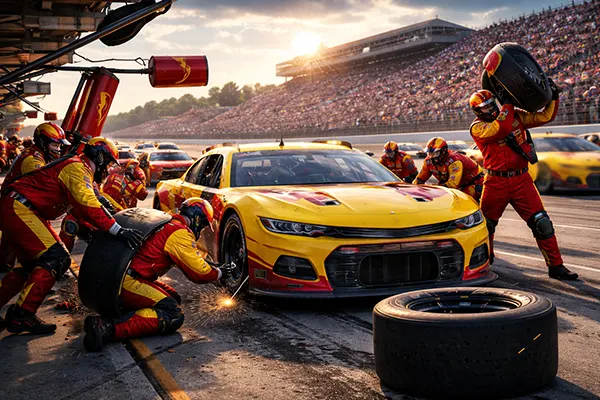
At the end of Stage 1 and Stage 2 on most ovals, NASCAR throws a caution. Cars line up, pit road opens, and teams get a guaranteed reset. That predictable reset is the reason stage racing changes the sport: instead of hoping for a yellow at the “right” time, crew chiefs know two yellows are built in and can anchor fuel and tyre strategy around them.
There is one important 2025-era nuance: on road courses, stage breaks are not always accompanied by a guaranteed caution. NASCAR removed guaranteed stage cautions on road courses starting in 2023 to avoid long caution periods and to keep the flow of green-flag racing, but stage points are still awarded at the stage endpoints. That one rule difference creates an entirely different tactical environment compared with an intermediate oval.
Stage points and playoff points: why teams care before the finish
Stage points are awarded to the top 10 drivers at the end of Stage 1 and Stage 2: 10 points for 1st, then 9, 8 and down to 1 point for 10th. Those points add directly to a driver’s total in the regular season and the playoffs, so a team that consistently runs 6th to 10th at stage ends can outscore a rival who finishes a few spots higher but never collects stage points.
There is also a playoff points layer. A stage win (finishing 1st at the end of Stage 1 or Stage 2) is worth one playoff point, and race wins are worth more playoff points, which carry into the elimination rounds. In practice, that means a driver can build “insurance” all year by winning stages even if they do not dominate races, and those playoff points can keep them alive when a bad race happens in September or October.
Because the value is real, teams often split their goals: some weekends they chase stage points early, other weekends they sacrifice them to set up the final stage. That trade-off is the heart of stage racing: do you take guaranteed points now, or do you build a car setup and pit sequence that peaks in the last 80–120 laps?
2) Pit strategy under stages: the tactical decisions crew chiefs actually make
Stage racing has effectively created planned “decision moments”. On ovals, those moments arrive at the stage cautions, and teams must choose: pit for four tyres, take two tyres for track position, stay out to win the stage, or pit just before the stage ends to gain time when others are trapped behind the caution. The choice is never made in isolation; it depends on tyre fall-off, how hard passing is, and where a team expects to be after the restart.
The most visible tactic is staying out near a stage end to grab stage points, then pitting when pit road opens under the caution. That can work if a team has a strong short-run car and can hold position for 5–10 laps, but it can also backfire if tyres are falling off quickly and the driver loses too many spots before the stage line. In 2025, with competitive parity and tight margins, that risk-reward calculation is often the difference between a safe points day and a disappointing result.
The opposite tactic is “selling” stage points to set up the long run: pitting earlier than rivals so the car has fresh tyres for the final green-flag laps of a stage, gaining positions while others are stuck on older rubber, and then restarting higher after the caution. This is why you sometimes see a driver outside the top 10 deliberately pit before a stage ends—they are not confused, they are playing the longer game.
Short-pitting vs stage points: the core chess match
Short-pitting means pitting under green before the stage break, even though it guarantees you will lose track position immediately. Teams do it when fresh tyres are worth enough lap time to “undercut” cars ahead. On tracks with heavy tyre wear, a short-pit can be powerful because the driver on new tyres can run faster laps for 8–15 laps and claw back time before the stage caution freezes the field.
The cost is stage points. If you pit before the stage ends, you are unlikely to be top 10 at the stage line. That is why the best short-pit calls usually come from teams that are either already comfortable in points, or from teams that believe they cannot win stage points anyway but can win the race by having the best long-run position and tyre life. Stage racing forces that honesty: you either have a stage-winning car, or you build a race-winning plan.
On road courses, the calculus changes again because stage cautions may not appear. Without a guaranteed yellow, a short-pit is closer to classic endurance-style strategy: you pit to hit a fuel window, avoid traffic, and set up the final stint. Stage points still matter, but the absence of a forced reset means teams can be punished harder for getting the timing wrong, especially if they pit into traffic or a caution comes out at the wrong moment.
3) How stage racing changes race craft, car setups and the bigger season picture
Stage racing has changed how drivers manage risk. A late-stage restart can be treated like a mini-finish because stage points are on the line. That encourages aggressive moves earlier in a race than you’d see in older NASCAR eras, particularly among playoff contenders who need points every week. It also changes how teams talk to their drivers: “protect the car” is still important, but there are now more moments where a calculated risk is rewarded.
It has also influenced car setup choices. With predictable resets, teams can bias toward short-run speed for restarts and stage sprints, knowing they will get multiple opportunities to regain track position. At the same time, Stage 3 is still the part that pays the trophy, so the best organisations try to find a balance: enough short-run grip to survive restarts, and enough long-run stability to maintain pace over a 40–60 lap run when the race settles.
Across the full season, stage racing rewards consistency. A driver who regularly runs 8th at stage ends can quietly build a strong points total even without many top-three finishes. That consistency matters even more because playoff eligibility and seeding depend on the season’s body of work, and because playoff points earned through stage wins can carry through elimination rounds.
What fans miss if they only watch the last 50 laps
Stage racing means the first 100–150 laps are not “warm-up”. Those laps are where teams decide whether they are racing for stage points, positioning, or the long-run. A driver running 12th may be executing a plan to short-pit and leap into the top five after the stage caution, while a driver running 2nd might be pushing hard simply to secure a stage win and the extra playoff point.
It also changes how you should interpret “who is fast”. A car that looks brilliant over 10 laps might fade badly on a long run, and stage cautions can hide that weakness by resetting the field. That is why analysts often talk about “short-run” versus “long-run” speed, and why a crew chief who understands tyre fall-off can turn a decent car into a contender through smart calls at stage breaks.
Finally, stage racing helps explain why some teams are satisfied with a 9th-place finish. If they banked stage points in both early segments, they may have achieved their strategic target for the day, especially in the regular season when stage points can secure a safer position in the standings. In 2025 NASCAR, the championship path is shaped by dozens of these small scoring wins, not just the headline race victories.