
Similar articles

Physical Preparation of Racing Drivers: Neck Strength, Endurance, Heat and Recovery
Modern motorsport demands far more than technical skill and bravery. By 2026, physical conditioning has become one of the decisive performance factors across Formula 1, Formula 2, endurance racing and GT championships. Drivers operate under extreme g-forces, cockpit temperatures exceeding 50°C, and race durations that test cardiovascular and cognitive limits simultaneously. Success depends on targeted preparation: developing neck strength to resist lateral loads, building aerobic and muscular endurance, adapting to heat stress, and applying structured recovery protocols that allow consistent performance throughout a demanding season.
Neck Strength and Resistance to G-Forces
During high-speed cornering in Formula 1, lateral loads regularly reach 4–6G, while braking zones can exceed 5G. This means a driver’s head and helmet, weighing approximately 6–7 kg combined, can effectively load the cervical spine with forces exceeding 30 kg. Without specialised conditioning, fatigue sets in quickly, compromising vision stability and reaction time. Neck training is therefore not optional; it is foundational.
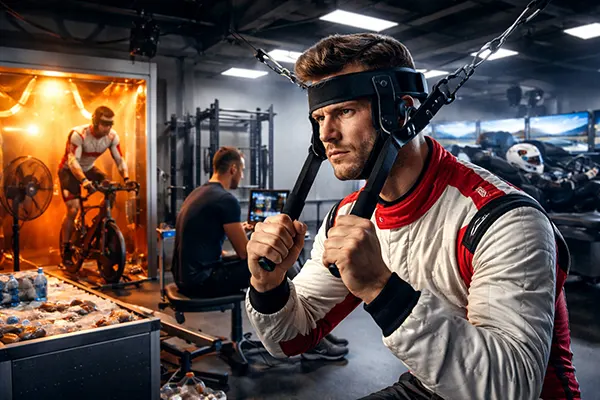
Contemporary driver programmes in 2026 rely on isometric and multi-directional resistance systems. Elastic band rigs, weighted helmets, pulley machines and custom-built neck simulators replicate race-specific vectors of force. Rather than generic gym exercises, training mimics cornering profiles from specific circuits, using telemetry data to reproduce the duration and intensity of sustained loads.
Importantly, neck strength work is integrated with scapular stability and upper back conditioning. The trapezius, sternocleidomastoid and deep cervical flexors must function as a coordinated system. Teams monitor muscle fatigue through EMG feedback and adjust workloads accordingly, preventing overuse injuries that can occur during tightly packed race calendars.
Functional Integration with Driving Simulation
High-level teams increasingly combine physical training with simulator sessions. Drivers complete neck-loading exercises immediately before or during simulator runs to reproduce the fatigue patterns experienced late in a Grand Prix. This approach conditions not only muscles but also neuromuscular coordination under stress.
Reaction drills are layered into these sessions. For example, light-based reflex systems or cognitive tasks are introduced while the neck is under tension. This reflects real racing conditions, where decision-making must remain precise despite physical strain. Research published in sports performance journals between 2023 and 2025 confirms that cognitive sharpness declines when cervical fatigue rises, reinforcing the need for integrated preparation.
By combining biomechanics, data analytics and applied sports science, modern programmes ensure drivers can maintain head stability and visual focus through the final laps, when margins are smallest and concentration must remain absolute.
Cardiovascular and Muscular Endurance
Race heart rates frequently average between 160 and 180 beats per minute, peaking above 190 bpm during intense battles or safety car restarts. In endurance formats such as the 24 Hours of Le Mans, drivers must repeat high-intensity stints across day and night cycles. Aerobic capacity, measured via VO2 max testing, is therefore benchmarked at levels comparable to elite cyclists.
Training blocks typically combine steady-state endurance work with high-intensity interval sessions. Cycling, rowing and running remain staples, but programmes are periodised around the race calendar. In-season conditioning prioritises maintenance and recovery, while off-season phases focus on expanding aerobic thresholds and muscular resilience.
Core stability and anti-rotation strength are equally critical. Under braking and cornering, drivers brace continuously against the cockpit structure. Targeted exercises such as Pallof presses, rotational cable work and unstable surface drills strengthen deep trunk musculature, reducing fatigue-related posture breakdown during long stints.
Grip Strength and Upper Limb Control
Steering systems without power assistance, common in junior formulas and some GT categories, require substantial forearm and hand endurance. Even in power-assisted systems, sustained steering corrections demand fine motor control under vibration and load. Grip dynamometer scores are routinely tracked to monitor progress.
Programmes include eccentric forearm training, rice bucket drills, heavy carries and resistance band steering simulations. These exercises are designed not merely for maximal strength but for repeated submaximal contractions over race distance. The aim is to prevent the forearm tightness that can reduce steering precision.
Upper limb endurance is also tied to injury prevention. Balanced conditioning across flexors and extensors lowers the risk of tendon irritation, which can otherwise accumulate over a season exceeding 20 race weekends.

Heat Adaptation and Hydration Strategy
In hot-weather events such as Singapore or Qatar, cockpit temperatures can surpass 55°C. Drivers may lose between 2 and 4 kilograms of body mass through sweat during a single race. Without structured heat adaptation, dehydration leads to reduced plasma volume, impaired concentration and slower reaction times.
Heat acclimation protocols typically begin 10–14 days before high-temperature events. Controlled sauna exposure, climate chamber cycling sessions and overdressed training runs stimulate thermoregulatory adaptations. These include earlier onset of sweating, improved sodium retention and stabilised heart rate under heat stress.
Hydration planning is individualised. Sweat rate testing determines fluid and electrolyte requirements. By 2026, many teams use real-time hydration monitoring through body mass tracking and blood markers, adjusting intake strategies across practice, qualifying and race day to maintain optimal plasma balance.
Recovery Protocols and Sleep Optimisation
Physical preparation does not end with the chequered flag. Recovery quality directly influences performance in back-to-back race weekends. Structured cool-down routines, contrast water therapy and compression garments are standard practice. However, evidence increasingly favours active recovery sessions and low-intensity aerobic work over passive methods alone.
Sleep management has become a central pillar of driver health. Long-haul travel across time zones disrupts circadian rhythms, affecting cognitive speed and hormonal balance. Light exposure scheduling, melatonin protocols supervised by medical staff, and gradual time-shift adjustments are now routine elements of race preparation.
Nutritional recovery focuses on glycogen replenishment, adequate protein intake for muscle repair, and anti-inflammatory food strategies. Omega-3 fatty acids, antioxidant-rich produce and balanced carbohydrate timing support systemic recovery. When integrated with data-led load monitoring, these measures allow drivers to sustain elite output throughout an extended championship season.