
Similar articles
IndyCar: Oval vs Road/Street — Why Setup and Strategy Are Built Around Different Priorities
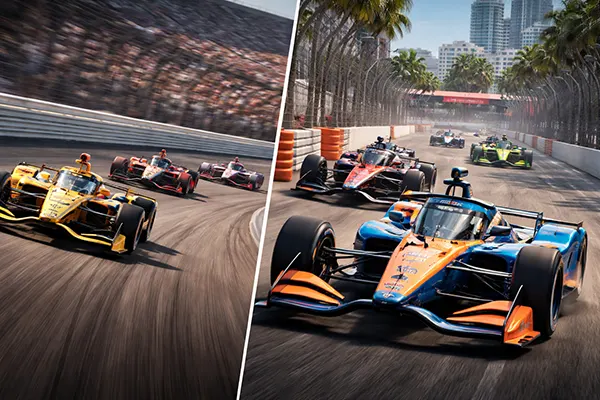
If you only watch IndyCar casually, it’s tempting to think an oval weekend is just a lower-downforce version of a road or street weekend. In reality, teams treat them as two separate engineering problems. On ovals, the car spends long periods loaded in one direction, the penalty for drag is brutal, and the race is often decided by traffic timing and caution patterns. On road and street circuits, you’re constantly rotating the car, braking hard, managing two dry compounds, and using overtaking tools with much more freedom. The result is that even when the chassis is the same, the mindset, the setup checklist, and the strategic “math” change completely.
1) Car configuration: aerodynamic philosophy and mechanical balance
The most obvious split is aerodynamic configuration. IndyCar runs distinct aero packages for speedways versus road/street circuits, and that decision immediately changes the target: on an oval you’re chasing low drag and stability in traffic, while on road and street tracks you’re chasing peak downforce, braking support, and rotation through slow corners. With the high-downforce road/street trim, you can lean on the car more under braking and through direction changes, but you also accept higher drag because top speed is less decisive than corner time.
On ovals, teams often accept a car that feels “locked in” rather than sharp. That’s because an oval car must be calm through long, sustained lateral load, and it has to behave predictably when the driver’s line changes by half a lane to pass or defend. If the balance is nervous, the driver ends up lifting more often, and that lift is usually more expensive than a slightly slower mid-corner attitude.
Mechanical setup follows the same logic. Road/street work prioritises compliance over kerbs, traction on corner exit, and keeping the tyres in the best temperature window after heavy braking zones. Oval work prioritises platform control and tyre contact under steady load. That can push teams toward different anti-roll bar choices, different damper attitudes, and different compromises in how “free” the car is allowed to feel on entry versus how stable it stays in dirty air.
What engineers actually chase on ovals (and why it can feel counter-intuitive)
On a road course, “good front end” usually means the car bites on turn-in and rotates quickly. On an oval, too much initial bite can be a problem: the car may feel fast for a single lap in clean air, but it becomes edgy when the driver is half a car width off the preferred groove or when a gust, bump, or traffic wake hits mid-corner. Engineers often prefer a car that is slightly less responsive but significantly more repeatable over a long run.
Because most corners are taken at very high speed, small changes in ride height, rake, and wing angle can create large swings in drag and stability. That’s why teams spend so much time mapping how the car behaves behind another car: a setup that is brilliant in qualifying trim can become difficult in the race once you’re in a pack and the aero balance shifts. Getting that “pack balance” right can matter more than the absolute headline downforce number.
Finally, the oval problem is asymmetric by nature. The car loads the right-side tyres much harder, and engineers work around that with pressures, cambers, and mechanical support choices that would look odd on a road course. The goal isn’t to make the car feel perfect in every corner direction; the goal is to keep it predictable in the one direction that dominates the lap while managing tyre temperature and wear without forcing the driver into costly lifts.
2) Tyres and grip management: two compounds vs one, and why that changes everything
Road and street races usually require teams to use both the primary and alternate dry compounds, which immediately makes strategy more elastic. You can short-run the softer tyre for track position, stretch the harder tyre for flexibility, or time the alternates around caution probability and traffic. The tyre you’re on isn’t just a grip level; it becomes a lever for when you can attack, when you need to defend, and how long you can stay out without falling off a cliff.
On ovals, the tyre situation is more straightforward on paper because teams generally don’t have the same “primary vs alternate” decision. That doesn’t mean tyres are simple. The loads are higher and more consistent, the temperature build is relentless, and a small imbalance can build into a big handling shift over a stint. If the front-right starts to go away, the driver can’t just brake five metres earlier to save it — the corner is still a high-speed commitment.
Grip also behaves differently because the racing line on ovals can change quickly with rubbering-in, marbles, and wind. A car that protects the tyres while running alone may still struggle if it overheats following another car. So the best oval setups often focus on reducing scrub and keeping the car stable enough that the driver doesn’t have to add steering, because steering input is heat, and heat becomes wear.
Why “tyre tactics” on road/street are more visible, but oval tyre work is just as decisive
On a street circuit, everyone can see the alternate tyre fall away: lap times drop, the car slides more, and the driver becomes vulnerable. That makes tyre choice feel like the headline story. The hidden part is that teams are managing brake temperatures, tyre surface temperature, and traffic gaps at the same time, because overheating the tyre on one lap can cost you for the next ten.
On ovals, tyre management tends to be expressed through discipline rather than obvious compound gambles. The fast drivers look calm because they’re minimising scrub, keeping the car on a precise arc, and making passes without overworking the front tyres. If they have to saw at the wheel to hold a line, the lap time loss is immediate, and the long-run drop-off gets worse.
There’s also a psychological difference. Road/street tyre work is often about choosing when to be aggressive. Oval tyre work is often about choosing when not to be. The best stints are frequently the ones where the driver resists the urge to force the car early, keeps the run clean, and is still able to attack late in the stint when others have burned their tyres fighting the car.
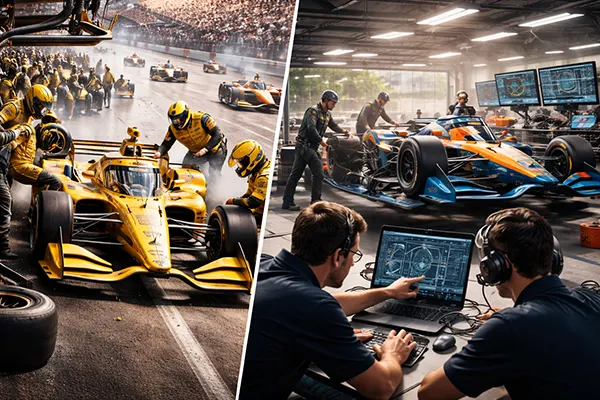
3) Race strategy: cautions, fuel windows, overtaking tools, and track position value
Road and street strategy is usually built around pit sequencing, traffic management, and the requirement to use both dry compounds. Because passing can be difficult on tight street circuits, teams will often prioritise clean air and undercut/overcut logic — even if the fuel number says multiple options are possible. The tactical picture is also influenced by overtaking aids used on road and street tracks, which can change how easy it is to convert a pace advantage into a pass.
Ovals are a different type of chess. Track position matters, but it is often more fragile because cautions can reshuffle everything and because drafting creates opportunities that don’t exist on road/street. Teams think hard about caution probability, where they might rejoin in the pack, and whether it’s better to be a few spots back with a stable car or a few spots forward with a car that overheats in traffic.
Fuel saving is also expressed differently. On road/street, saving is typically done into heavy braking zones and with controlled exits. On ovals, saving is about lift-and-coast discipline, managing throttle traces, and using the draft intelligently. A driver who saves well without losing too much momentum can open a strategic window that simply doesn’t exist on a street circuit, especially when a caution lands in the “wrong” place for others.
How a pit call that’s “obvious” on road/street becomes risky on an oval
On a road course, an early stop can be a clean undercut if you have space and the alternate tyre is working. On an oval, an early stop can drop you into the wrong traffic, cost you time in dirty air, and force you to burn the tyres to recover. Because the lap time sensitivity to aero wake is so high, “clear track” is often worth more than the theoretical advantage of fresh tyres.
Restarts are another major separator. Road/street restarts are about positioning into the first braking zone and managing wheelspin. Oval restarts are about lanes, momentum, and the aerodynamics of being boxed in. Strategy calls are often made with restart exposure in mind: where will we restart, who will be around us, and will the car be stable enough to survive two-wide or three-wide moments without overheating the tyres?
Finally, the way teams use their tools changes with track type. IndyCar’s road/street racing includes overtaking aids that make timing and deployment part of the battle, while ovals lean more on draft timing, traffic placement, and keeping the car efficient enough that the driver can commit without lifting. That’s why a team can look “clever” on a road course with aggressive compound timing, yet look even smarter on an oval by simply putting the driver in the right air at the right moment.